Level 3 Rail Engineering Technician
Curriculum Breakdown & Roadmap
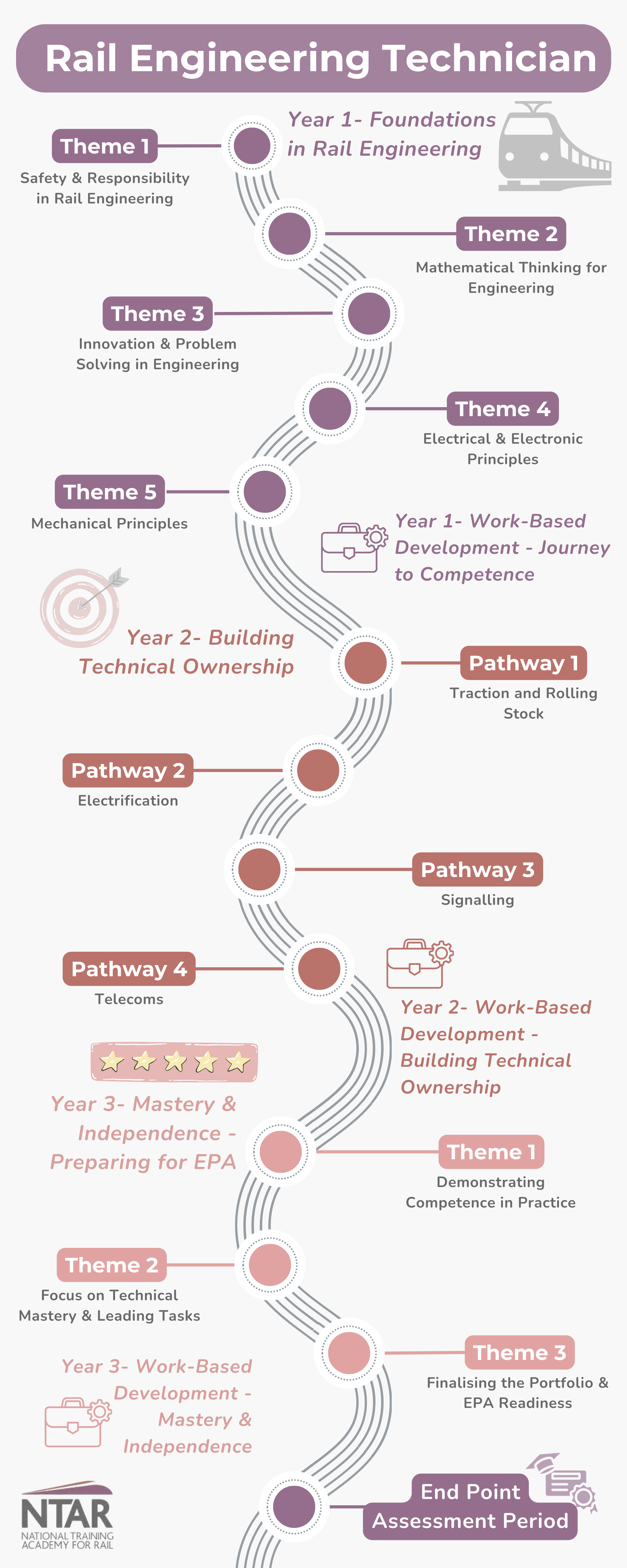
Roadmap
Overview
“Providing technical support to engineers working on the rail network and trains.” - Skills England
Year 1: Foundations in Rail Engineering
In Year 1, apprentices begin their journey by building core technical knowledge and safe working practices. Through themed learning, they explore health and safety, mathematical methods, problem-solving, and key engineering principles. CIAG is introduced to support career awareness and progression.
Work-Based Development:
Year 1 is about bedding into the workplace. Apprentices begin by observing experienced colleagues, understanding workplace culture, and gradually engaging in technical tasks. The emphasis is on confidence-building, safe working practices, and developing professional behaviours.
Year 2: Building Technical Ownership
In Year 2, apprentices begin applying their technical knowledge to real-world systems, focusing on traction, braking, HVAC, and passenger safety. CIAG continues to guide career exploration, with roles such as technician and systems engineer coming into focus.
Work-Based Development:
Year 2 focuses on active contribution. Apprentices begin applying technical knowledge, supporting maintenance tasks, and understanding how systems interact. They move from observation to guided practice, with increasing responsibility.
Year 3: Mastery & Independence - Preparing for EPA
In Year 3, apprentices transition into confident professionals, applying their skills independently across complex rail engineering systems. CIAG supports final career planning, helping apprentices prepare for progression and professional opportunities.
Work-Based Development:
Year 3 is the final stage of the Journey to Competence. Apprentices shift from learners to emerging professionals, demonstrating independence, confidence, and readiness for assessment and progression.
Rail Engineering Technician - Pathways
-
The Traction & Rolling Stock pathway relates to the engineering systems found on trains themselves. Apprentices develop the skills to support the maintenance, inspection, fault‑finding, replacement, and testing of onboard systems and components. The standard focuses on ensuring trains remain safe, reliable, and operational for customers.
Work may involve brakes, doors, electrical systems, bogies, motors, and other train-based equipment, with technicians typically operating in depots or maintenance facilities. -
The Electrification pathway covers overhead line equipment and related electrical systems that power the railway.
Apprentices learn to support engineers with the construction, installation, renewal, maintenance, enhancement, and fault‑finding of electrification assets. They also help ensure safety‑critical electrical equipment is tested, compliant, and reliable. -
The Signalling pathway focuses on apprentices supporting safety‑critical signalling infrastructure that controls train movement, ensuring the safe operation of the network. Their duties involve maintenance, inspection, functional testing, installation, and diagnosing equipment faults.
Equipment can range from traditional relay-based systems to modern, computer‑based signalling technologies. -
The Telecommunications pathway covers communication and information systems essential for operational safety and performance across the railway.
Apprentices help install, maintain, test, and fault‑find systems such as fibre networks, radio systems, station comms, and lineside telephony, supporting safe and efficient operations.
Frequently Asked Questions
-
This appprenticeship standard is set to a level three.
-
36 months (plus 6 months once into Gateway for EPA). This may be reduced if an apprentice has prior learning and has already gained relevant knowledge and skills.
-
The End-Point Assessment (EPA) will include a Portfolio of Evidence and an Occupational Competence Validation Interview (Viva). This will then have Independent Assessment against the UKSPEC EngTech requirements.
-
Please do not hesitate to contact: apprenticeshipprogramme@ntar.co.uk